

- Is InboxAlly Worth It? Here’s a Look at the Cost vs. Value - September 2, 2026
- The Cheaper Way to Learn DTC: A Roadmap for Founders - August 21, 2026
- Domain Reputation Dropped? Here’s a Guide on How to Recover - May 22, 2026
Last Updated on August 21, 2026 by Stephany Montero
If you’re starting or scaling a DTC business and find valuable information too expensive, you’re not wrong. There are plenty of DTC courses, bootcamps, and coaching that provide awesome content but come at a high cost, and let’s face it, when you’re starting and / or scaling a business, the last thing you need is to spend unnecessary money.
No matter where you’re at in your founding journey, you should be well-versed when it comes to your customers, products, market positioning, pricing, marketing, inventory, and finances. Making strategic decisions about these parts of your business should come from a place of confidence, so it’s important to take the time to learn and immerse yourself in these subjects.
Free vs Affordable Learning

While there are free learning tools available, it’s important to get information from informed, trusted sources. Paying for the right information saves you much more in the long-run than learning incorrect direct-to-consumer ecommerce skills. Budget is a huge consideration when deciding what route to take in your learning journey.
There are a few great examples of official platforms that provide free DTC resources such as Meta Blueprint, Google Skillshop, and Shopify Academy. These platforms provide information based around the mechanics of running a DTC operation but aren’t focused on business strategy.
Finding the right balance between your tools and strategy is key.
This roadmap will guide you in what subjects would be great to learn, and when.
Learning DTC Fundamentals Through Experience
As a founder, it can feel like everything needs your attention at the same time, but it’s important to pause and start your learning using a calculated, proactive approach. You can learn a lot by doing as you gain experience. Being intentional in understanding your business and moving it forwards will ensure the lessons are frequent and worthwhile. Here are a few areas to start.

1. Who Are Your Customers, and What Problem Are You Trying to Solve?
You know your product better than anyone. We often get caught up in the features and benefits when explaining our product to customers, but what’s more important to a consumer is “how is this product fixing my issue?” Customer demographics are interesting, and it’s important to know exactly who your product is serving. Try to decipher buying patterns by having conversations with people about their needs, and looking at competitor reviews and community discussions. Doing so will easily tell you what works for potential customers and what doesn’t.
If you’re well into selling your product already, you can gain insights from your existing customers by requesting surveys or reviews.
2. Know Your Product and Positioning
Once you’ve understood customers’ needs, look at how your product is positioned in the market and how you’re marketing it. Clearly define your unique selling proposition (USP). What truly sets your product apart from competitors? Communicating the value is key.
There are various strategies you can use to help figure out what works best. Your messaging framework can be tested on audiences by using different captions, images, and bundle offers. Measure which options garner better results to find your marketing sweetspot.
3. Understand Your Pricing and Economics
Calculating your product cost is only the tip of the iceberg. Your cost structure should also take the following into account:
- Packaging
- Shipping
- Online payment fees
- Returns
- Discounts/offers
- Fulfillment
This gives you a better idea of the economics behind a sale. Your overall decision-making will be dependent on your gross margins, average order value, and operating profit. Once you understand the numbers, your decisions will be informed and strategic.
4. Create Clear Conversion Paths
Now you’re at the point where you’ve gotten to know your customers, and you know your product positioning and pricing. The next key learning should be around conversion strategy. There are clear recommended guidelines for helping customers make purchases using the classic marketing funnel. Setting the foundations for a clear path to convert takes time and usually needs a bit of analytics.
The goal is to make a purchase or path to purchase as simple as possible. Too many steps, descriptors, or considerations can cause users to drop-off easily. Clear call-to-actions with compelling content and images are essential.
5. Acquisition and Retention Strategies
For the most part, it costs more to gain a new customer than it does to keep an existing one. Your acquisition and retention strategies should run parallel. This is where your customer experience walks the walk. You already spend time and money on marketing and proactive selling, especially to new customers, but what are you doing to ensure your existing customers stay?
Looking after customers to ensure they make repeat purchases is easy. There are also other tactics you can use, such as subscription-based models, referral programs or gifts with purchases.
6. Managing Operations
When it comes to your operations, being organized is one of your biggest assets – a skill that most times can’t be taught! Scaling a business generally makes people think of increased revenue, but it also means growing in your operation functions such as:
- Inventory
- Supplier relationships
- Cashflow
- Documentation
- Customer experience
- Recruitment
- Forecasting
This is where business sustainability is tested. As a founder, your learning journey will ping pong around, and it can feel like you’re all over the place, but by anchoring your growth in running an efficient operation, there’s not much that can go wrong.
7. Invest in Your People and Processes
Running an efficient operation will also depend on the processes and tools you have in place as well as the people behind them. There’s a misconception that having more team members means you must be more successful, which is not the case. Having fewer people follow clearly defined processes for your day-to-day work will leave very little room for error.
Taking the time to learn and understand what your business processes are will also help you decide what type of tools you need to run things smoothly.
Top tip! Don’t forget that the key to having tools do the smart work is to ensure they integrate with one another and that you’re using good quality, clean data!
Experience Is Something Money Can’t Buy

The 7 fundamentals above are a great starting point for your learning journey, but combining your day-to-day, hands-on experience with course material will really set you up for success.
Building a DTC brand comes with plenty of trial and error, and not everything goes according to what you’ve learned theoretically. It’s important that you are flexible and open to assessing what works and what doesn’t. Testing your fundamentals can take years, and over time you’ll build business-specific knowledge that general learning material can’t provide.
The Right Balance Between Free and Expensive Learning Programs
Affordable templates, calculators, checklists, and playbooks are the best middle ground between free advice and a costly education program. The DTC Operator is one example of this approach. Created by operator and founder Suze Dowling, it offers editable templates, practical frameworks, and playbooks across the 7 fundamentals.
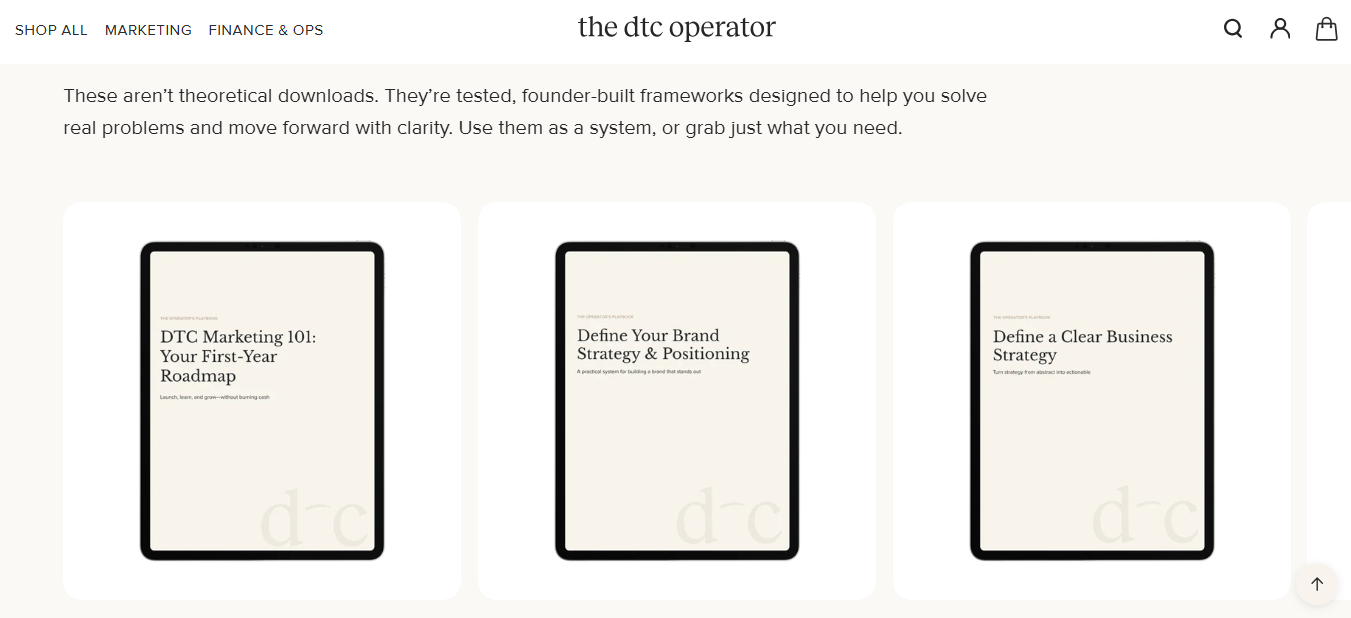
As a founder, you have access to free resources, including the DTC Foundations Bundle and a tracking and email setup checklist. More focused paid options include the $19 DTC Marketing 101: Your First-Year Roadmap and $9 resources for areas such as diagnosing marketing performance and managing agencies. Larger playbooks are available for founders working through a more involved challenge.
This allows you to choose a resource in proportion to the problem rather than buying a complete curriculum to answer one question.
The benefit of The DTC Operator is that it is an operator-built, battle-tested framework. This is more than learning about an email marketing platform. It provides you with the groundwork and structure to transform your learning into an actionable business strategy.
Learning DTC Skills from Communities
Don’t underestimate the experience of other founders. Listening to your peers provides another layer of learning: business rapport. Starting and scaling a DTC brand is hard work, so it’s helpful to hear about parallel experiences.
Check out communities on Reddit, LinkedIn, podcasts, and local networking opportunities. What’s useful about these forums is finding commonalities… have most people had the issue with a particular software, how do other businesses approach customer experience etc.
Keep in mind, context matters, and these are just other founders’ opinions. So be sure to consider the source, keep an open mind, and be cautious.
Be Confident in Your Business Skills

The cheaper way to learn DTC is not about finding one resource with every answer. There is no one-size-fits-all course that can provide you with all the materials you need. It’s a combination of learning using reliable information, key customer insights, and building a strong business structure.
This approach allows founders to learn in a way that is relevant to their current stage, rather than trying to master every aspect of DTC at once. Every customer interaction, campaign, product launch, operational challenge, and trial-and-error moment adds another layer of practical knowledge.
Those lessons form something no generic course can provide on its own: a business-specific playbook shaped by real results. That is what makes this approach more than simply a cheaper DTC education. It can also be a more focused, flexible, and useful way to build the confidence needed to start, scale, and make stronger decisions as the business evolves.



 English
  German
  Spanish
  French