
- Email Deliverability for Real Estate Agents - septiembre 28, 2026
- How to Build an Outsourced Marketing Team (Scoping, Sourcing, and Communication) - septiembre 4, 2026
- Best Marketing Talent Platforms: How to Choose the Right One - agosto 14, 2026
Last Updated on agosto 10, 2026 by Sussan Porras
Creative Circle is known for being good at fast staffing. Need a designer by Monday, a copywriter for a product launch, or a producer for a six-week sprint? That’s the job a staffing agency is built for, and for years that was all most companies needed. But along the way, creative requirements have changed.
Marketing teams now go looking for talent when they need to build a growth team, test a channel before committing to a full-time hire, or find a senior manager or exec who has deep experience.
Those are harder problems than just filling a seat, and they’ve given rise to alternatives built differently from traditional staffing agencies like Creative Circle (now called “Everforth Creative Circle” following a parent company rebrand).
Here’s how the field breaks down, and how to tell which model fits the problem you’re hiring for.
What to Look for When Replacing a Staffing-Style Creative Shop

Before comparing Everforth Creative Circle alternatives, get clear on what you’re shopping for. The companies on our top alternatives list are running on different models.
Traditional staffing agencies employ recruiters who source candidates against your job description and bill at an hourly rate with a markup. Their strengths are speed and volume, and they shine when the role is well defined.
Self-serve marketplaces flip the work back to you. There’s an enormous talent pool and low friction, but you write the posting, screen the portfolios, and take your chances on quality.
The third group, vetted talent platforms, puts an evaluation layer between the pool and the client. Someone at the platform scopes your needs, screens the talent, and recommends a match. The people they recommend tend to be more experienced than a staffing agency’s roster.
Those categories blur at the edges, and every company in this space will tell you it vets carefully. So skip the labels and ask sharper questions:
- Who actually does the evaluating, and have they done the job themselves? A recruiter can check references and confirm software skills. It takes someone who has done the work to know whether a candidate’s marketing record was skill or luck.
- How experienced is the talent? There’s a difference between a capable coordinator and someone who has built the team before, and you should know which one you’re buying.
- How wide is the skill set? Creative staffing historically meant designers, writers, and producers. If your gaps now include lifecycle marketing, acquisition, or analytics, confirm they actually staff those roles.
- How does the contract flex? Look at cancellation windows, whether you can scale hours up or down, and what happens if you want to hire the person outright. Those matter more than the day rate.
- How fast can someone credible start? Weeks matter when a launch is on the calendar.
Price the whole answer, not the hourly figure. A cheaper rate that costs you a quarter of missed growth is not a bargain.
The 5 Options Worth Comparing
1. Aquent
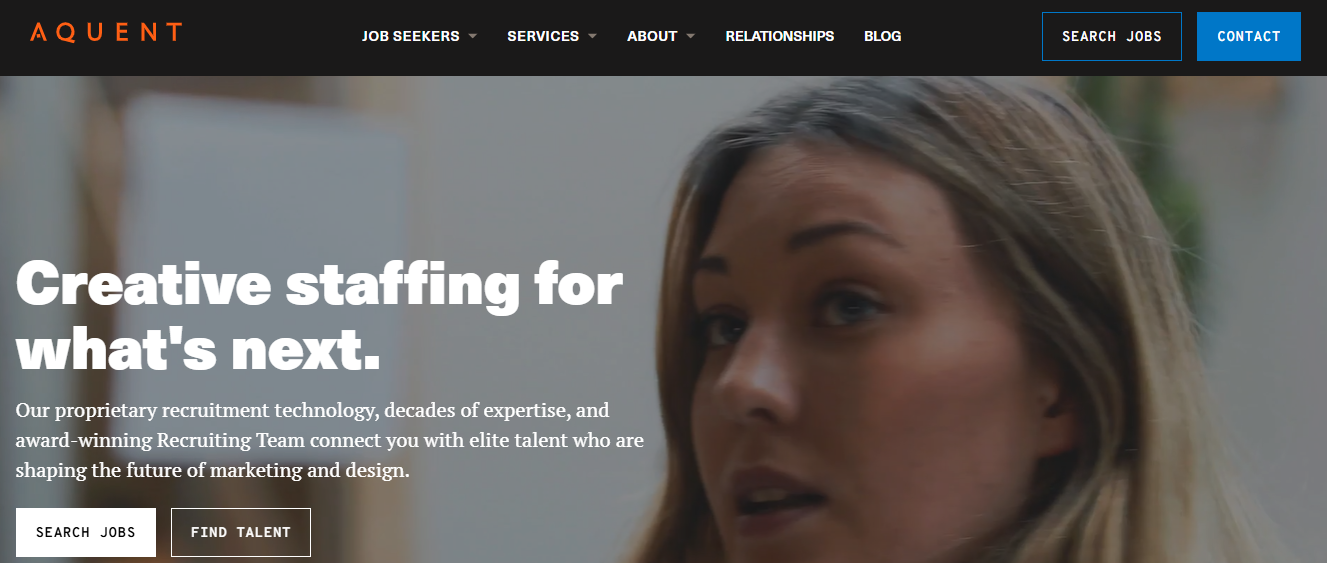
Aquent is one of the largest marketing and creative staffing firms in the country, and it has been doing this work for decades. You can hire freelance, contract, contract-to-hire, or permanent, and the firm goes further than most competitors on the administrative side, handling payroll and employer-of-record work even for talent you found yourself. There is also a trial window on temp-to-perm placements, so you can see someone work before making the role permanent.
Aquent recruiters build a search profile against your brief and hand back a short list rather than a pile of resumes. That is real screening, and for well-defined roles, it works.
Recruiters can confirm someone shipped the work and that references check out. Whether a candidate’s results came from skill or from a good quarter is a harder call, and it usually takes someone who has done the job to tell the difference.
Breadth is the other thing to weigh. The bench is deep in design, UX, content, and production, which is exactly where creative staffing has always lived. Growth, lifecycle, and analytics roles are thinner ground.
A good match when:
- Well-defined creative, design, or UX roles where you want the widest possible pool
- Situations where you need someone to handle contracts, payroll, or worker classification
2. 24 Seven
24 Seven covers the same creative and marketing ground as most staffing firms, but with a consumer-brand tilt. Fashion, beauty, and retail are their specialties, and if you are hiring in those categories, the recruiters will already speak your language.
The company has also grown well beyond staffing, acquiring a family of brands that add design work, marketing consulting, and embedded teams that sit inside your organization. In principle, that lets you scale from a single freelancer up to a full team without switching vendors, though how smoothly separate brands hand off to each other is a fair thing to ask about.
Vetting is recruiter-led, supported by matching tools the company built in-house. Recruiters run the process end to end, from screening and interviews through offer and onboarding, which takes real work off your plate. The same caveat applies here as anywhere in traditional staffing: Someone who has recruited marketers for years knows the market well, but the judgment they bring is about hiring, not about the discipline you are hiring for.
A good match when:
- You are hiring for a consumer brand and want recruiters fluent in your category
- You want a staffing firm with room to grow into bigger engagements over time
3. Right Side Up
Right Side Up covers more ground than anything else on this list. You can bring on a single fractional marketer, commission a full agency team for a cross-channel initiative, or use their recruiters to hire someone full-time, all through the same relationship. The company positions itself as a “third way” between agencies and staffing firms. That means the engagement model can become a decision you make after diagnosing the problem instead of before.
Vetting is another major differentiator. Marketers apply to join the collective and go through a multi-step evaluation led by former in-house marketing leaders. The evaluation covers functional expertise, communication, seniority, and availability, and the people judging the talent have done the work themselves.
Terms are flexible for Right Side Up. No long-term contracts, hours that scale up and down, and an invitation to hire their talent away from them if it turns into a fit. They also move quickly, recommending candidates in days rather than the weeks a search normally takes.
Their center of gravity is growth and performance marketing, so creative work runs toward ad creative and brand storytelling rather than catalog production or packaging design.
A good match when:
- You need marketing judgment rather than just production hours, especially for acquisition, lifecycle, or analytics work
- You want to test a channel or a role before committing to a full-time hire
4. MarketerHire

MarketerHire’s whole purview is marketing. The network covers growth, paid social and search, SEO, lifecycle, content, analytics, and fractional CMO work. Everyone in the pool is a marketer, and everyone doing the matching is thinking about marketing problems, which shows up in how quickly they land on the right profile.
Matching is concierge-style. You describe the need to their team, and they come back with one or two candidates rather than a stack to sort through, usually within a couple of days. Vetting combines performance data the company keeps on its network with skill reviews and a video interview covering communication, critical thinking, and professionalism. If a match does not work out, they will rematch you at no additional cost.
Their strength is marketing strategy and performance work, so if your real need is high-volume creative production, a staffing firm built for that will give you more depth than a platform oriented around marketing specialists.
Pricing is at the top end, and their model assumes a real budget behind the engagement, so one-off tasks and small projects aren’t a good fit. Talent is remote and fractional, meaning your marketer is most likely managing other clients each week.
A good match when:
- You need one senior specialist in a specific channel, and you need them working this week
- You would rather be handed a short list than browse profiles yourself
5. Upwork
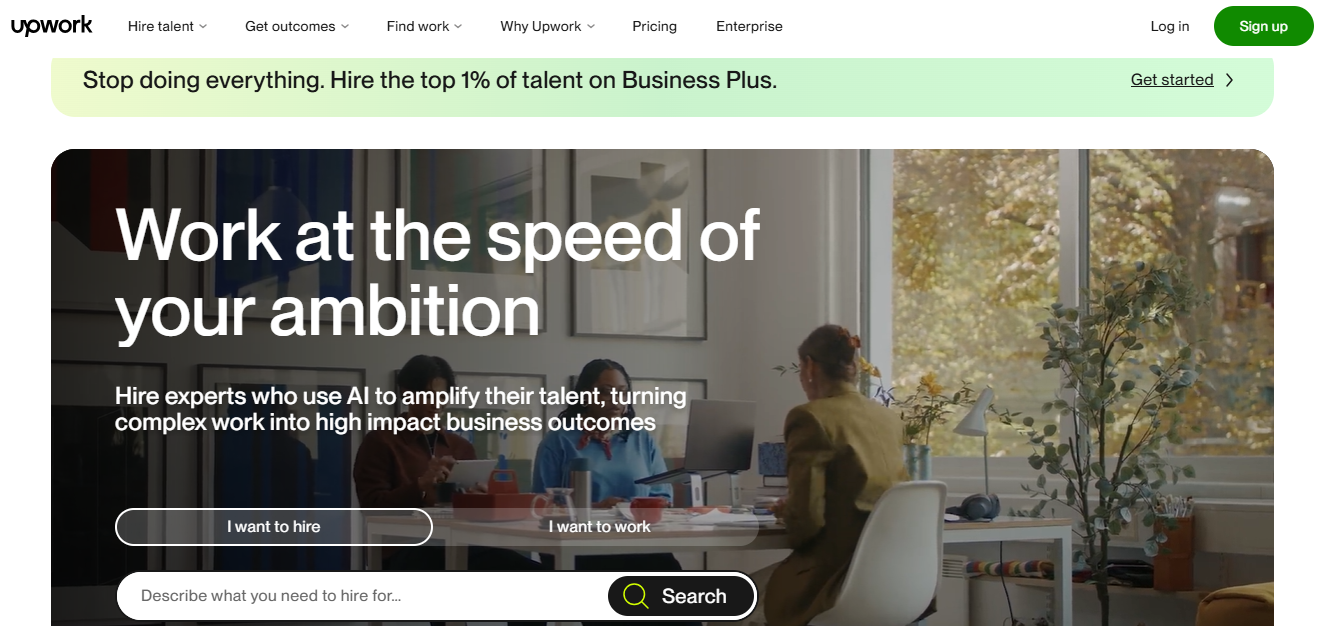
Upwork is the largest self-serve option on this list, and the one that puts the work on you. You post a job or search profiles across a global pool, negotiate rates directly, and manage the relationship yourself.
Vetting is reputation-based, built on ratings, job success scores, and badges freelancers earn over time on the platform. There’s one human-reviewed tier, where Upwork’s own team screens top talent in select categories, but it’s invitation-only, and only clients on its business plans will see those results. Upwork has also added AI tools that build you a shortlist quickly, which saves time on the first pass but doesn’t replace your own judgment on quality. For the most part, you are the one deciding who’s good.
The economics are the draw. Rates run well below staffing markups, and you pay per contract rather than on a retainer, so a one-off deliverable costs what a one-off deliverable should.
Screening portfolios, running interviews, and judging quality all become your job, and hiring a bad fit happens often enough that you may want to leave in your budget for a false start.
A good match when:
- The deliverable is well-defined, and you can evaluate the output yourself
- Price matters more than hand-holding, and you have the time to screen candidates
Side-By-Side Comparison
| Company | Model | Vetting | Talent seniority | Contract flexibility | Pricing model |
| Aquent | Staffing | Recruiter-led, talent agents | Junior to senior | Freelance to permanent; temp-to-perm window | Hourly rate + markup |
| 24 Seven | Staffing (+ acquired brands) | Recruiter-led, in-house tools | Junior to senior | Freelance to embedded teams | Hourly rate + markup |
| Right Side Up | Vetted platform | Former in-house marketers | Senior, some manager-level | No long-term contracts; scale hours; poach-friendly | Engagement-based |
| MarketerHire | Vetted platform | Data + skill review + interview | Senior | Month-to-month; free rematch | Premium, assumes substantial budget |
| Upwork | Self-serve marketplace | Reputation-based; Expert-Vetted tier on paid plans | Full range, you judge level | Per contract, no retainer | Rates + platform fees |
So, Which One Do You Need?
If you need a designer starting Monday, call a staffing firm. Aquent and 24 Seven are good picks here. The role is well defined, and a recruiter can fill it fast.
If you have one deliverable and you’re on a tight budget, use Upwork. A landing page, a batch of product photos, a set of display ads. Write a clear brief, hire someone with a track record in that specific thing, and keep the scope small enough that you can judge the result yourself.
When someone is going on leave, either a staffing firm or a talent platform works, and seniority decides it. Covering a coordinator is a staffing problem. Covering a director means finding someone who can make decisions in that role, which is a harder match.
If you want to test a channel before you hire for it, look for fractional talent. Bring in someone who has run the channel elsewhere, find out in a quarter whether it works for you, and use what you learn to write the job description if it does.
If you’re hiring your first real marketing leader, or building your team from scratch, talk to a company that does both fractional work and full-time recruiting. You may not know yet whether the answer is a hire or a consultant, and it helps to work with someone who does not need you to decide that up front.
The Logistics of Switching

Most of what goes wrong in a switch has nothing to do with the talent you pick. It’s the gap between contracts where a launch stalls, or the contractor you’d have kept turning out to be locked behind a non-solicitation clause. None of it is complicated, and all of it is easy to miss when you’re moving fast. Get these four things sorted:
- Read your current contract before you talk to anyone. Notice periods, minimum commitments, and non-solicitation clauses all shape what you can do and when.
- Ask whether you can keep the person who is working out. If a contractor from your current agency has been good, find out what it takes to bring them along or hire them directly. Some agreements allow it for a fee. Others block it for a stretch after the contract ends.
- Overlap the handoff. Line up the new arrangement before the old one lapses, especially if a launch sits in the gap. A week of paying twice costs less than a stalled campaign.
- Get conversion terms in writing. If you might hire a contractor full time later, know what that costs going in. Terms vary widely from one vendor to the next.
Before You Sign With an Everforth Creative Circle Alternative
The easiest move when leaving a staffing agency like Everforth Creative Circle is just to call a different staffing agency.
Sometimes that works, but it may set you up for disappointment. And if you’re going to make a switch, you should get what you need long-term.
So ask the questions that separate these companies before you sign anything. Who evaluates the talent, and have they done the work themselves? What happens to the contract when your needs change in six weeks? How far does the bench run past design and production? Those answers will help you sort the field.




 English
  German
  Spanish
  French