

- How to Replace a Marketing Agency Without Losing Momentum - octubre 10, 2026
- Before You Buy That Expensive Ecommerce Course, Read This - agosto 14, 2026
- The Best Refersion Alternatives for E-commerce Brands in 2026 - junio 24, 2026
Last Updated on agosto 14, 2026 by Sussan Porras
You’re trying to build an ecommerce business while cash is disappearing into inventory, packaging, ads, freelancers, shipping, and a bunch of other expenses you didn’t fully anticipate six months ago. Then some random guru online tells you that the answers to all your problems can be found inside their $3,000 ecommerce accelerator (which is conveniently on sale for $2,499 “for a limited time, so act now”).
Maybe the answers really are there, just waiting to be purchased… but that’s an awful lot of money to spend on a pretty big “maybe” when you’re still figuring things out.
Important Things to Know
- Expensive ecommerce courses mostly sell organization and convenience, not top-secret information. This doesn’t mean they’re “useless”… I wouldn’t go quite that far; but founders working with smaller budgets can recreate a surprising amount of similar value by combining free or lower-cost education through online academies, operator resources, books, communities, and videos.
- The best resource depends on what you’re trying to learn.
- Actually running your business is part of the curriculum. No book, video, template, or
$3,000($2,499! Act now!) course can replace testing ideas with real customers and learning from what happens.
| If you’re thinking… | Start with… | Why |
| I need to learn the basics. | Free platform academies | They’re structured and beginner-friendly education straight from the platforms you’re using (or will be) |
| I know the theory, but how do I actually approach it? | Operator-built playbooks, frameworks, and templates | These are practical frameworks you can apply directly to your business on an as-needed (and when-needed) basis |
| How should I think about this? | Books | They provide relatively inexpensive access to evergreen fundamentals. |
| Has anyone else dealt with this? | Comunidades | These open doors to real-world advice from founders and operators who have faced similar problems. |
| Can someone just show me how? | YouTube | Certain channels are great fro tactical walkthroughs, demonstrations, and examples. |
I’ve always been a fan of learning as you go, especially when you’re working with a limited budget, but the trick isn’t just about finding information: it’s finding the right kind of information for the problem(s) you’re actually trying to solve.
The good news is that ecommerce founders and operators have access to an enormous amount of genuinely useful information without buying a giant course. They just have to know where to look.
If this sounds like you, read on, because I’ll share some of the best free and reasonably-priced operator-built-template kits, academies, books, communities, and tools for founders who need resources and education at a much more accessible cost.
Free Platform Academies for Learning the Tools

Best for: “How do I do X?”
If you want to understand how a platform works, start with the company that actually built it.
Some of the oft-used tools you’ll be oft-using yourself offer free academies and education that covers all the things you need to understand about a given platform. These include:
- Shopify Academy: The catalog of courses is huge (over 200 free courses, as of this writing) that cover everything from the basics through developer tools and automations. The Shopify Academy list might seem overwhelming at first, but you can filter by subject, with “Getting Started” as its own group of courses.
- Klaviyo Academy: Another potentially “overwhelming” course list, Klaviyo provides a ton of courses that help founders master their email and SMS marketing, and automated customer journeys to grow their business.
- Meta Blueprint: Specifically for Meta, all the courses for growing your business on the platform are free and self-paced, although proctored certification exams (if taken) do have a fee attached.
- Google Skillshop: Training courses and certifications cover Google Ads and marketing, using analytics, creating a business profile, and other related Google products.
- TikTok Academy y TikTok Shop Academy: These free platforms provide self-paced courses (and in some cases, certifications) that can be useful depending on if you’re running ads, performing audience research, or generating leads (TikTok Academy), or running e-commerce operations and shops (TikTok Shop Academy).
- HubSpot Academy: This free course set covers everything from inbound leads and social media to email and content marketing.
- Amazon Ads Resources: If you’re a DTC founder who will be running ads and partnering on Amazon, this is a free library filled with resources that cover tactics, general advertising, campaign forecasting, ad management, and more.
The upside to all of these is that they’re free, structured, generally very current, and are a great place to learn the fundamentals.
The biggest downside is that while they provide all the education needed to succeed on a given platform (their own), they don’t necessarily teach you how all of the pieces of an ecommerce business actually fit together.
Operator-Built Playbooks and Templates for Turning Advice into Action
Best for: “How should I actually approach this?”
This is an important middle ground between the free academies and resources and the über-expensive courses vying for your money.
Operator-built playbooks and frameworks are usually designed to help you do one specific thing better, whether that’s planning a launch, building a pricing strategy, mapping your positioning, improving retention, or evaluating your margins.
I don’t know that 40 hours of expensive video lessons are as useful as a spreadsheet and proven framework if your biggest concern right now is how much inventory you should order for Q4. Somebody else had to make a similar inventory decision with real money on the line, they’ve been where you are, and they’ve created the solution for figuring it out.
There’s a lot of value in operator-created frameworks like that, and you can find playbooks and templates that solve just about any problem you’re facing.
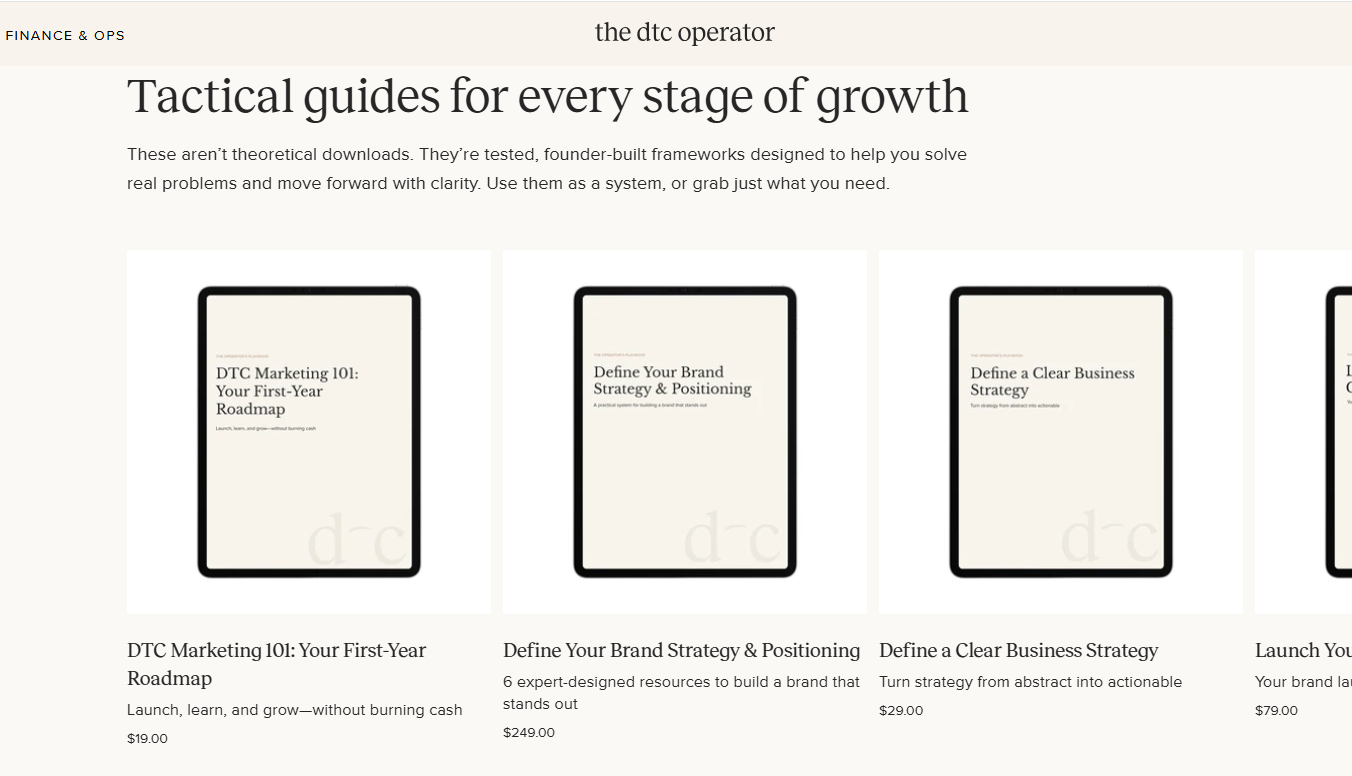
The DTC Operator is a great example because instead of packaging everything into one massive (and expensive) ecommerce course, the resources are organized around individual problems that founders or ecommerce teams need to solve.
It’s basically like buying the chapter you need, when you need it, instead of the entire textbook. If you’re struggling with positioning, you can invest in a playbook for positioning. Six months or a year from now, your newest challenge might shift to inventory planning or customer retention. You can come back for those when they’re actually relevant, instead of paying upfront for dozens of course modules you might never watch or need.
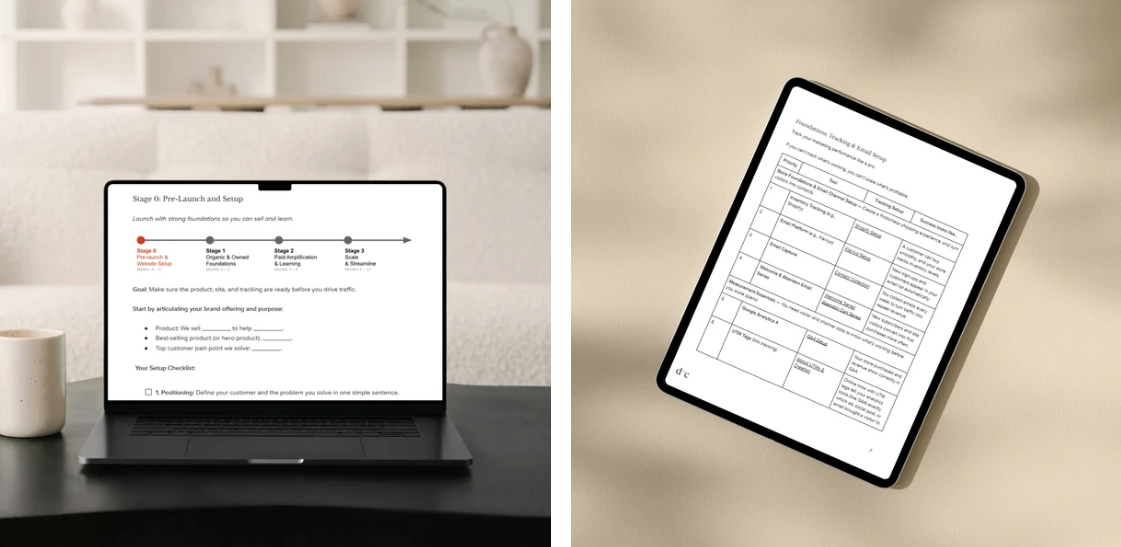
The DTC Operator offers playbooks and editable templates for ecommerce founders and businesses, covering everything from vendor contracts and negotiations, to marketing planning, positioning, branding, finances, strategy, supply chains, paid media, launches, team management, general planning, and a lot more, and they’re all built around real operator experience. Founded by Suze Dowling, The DTC Operator consists of all the playbooks she wishes she would have had when she was figuring everything out “the hard way,” so you don’t have to.
Buying a spreadsheet won’t fix your margins and downloading a launch framework doesn’t guarantee a successful launch; you’ll still need to understand your customers, make judgement calls, and actually implement what you’re learning. But these are good tools to have on hand for doing the work.
Before considering any operator-built resource, I’d ask a few quick questions:
- Who built it (and do they actually know what they’re talking about)?
- What problem does it solve? (The more targeted the resource, the quicker you’ll reach the solution.)
- Is it editable? (Or can it be made editable?)
- Does it explain the thinking behind the template? (I think it’s important to understand the “why” behind instruction, not just how to fill it out.)
- Can you use it more than once?
When you’re bootstrapping, resources like those you’ll find at The DTC Operator are incredibly useful.
Books for Learning How to Think (Like a Founder)

Best for: “How should I think about this?”
There’s something almost comical about paying thousands for a course only to discover that much of the “proprietary” framework sounds like a business book you could have bought for twenty bucks.
I’m not saying that books and courses are interchangeable; a great course can provide structure, accountability, and more hands-on instruction. When you’re trying to make every investment dollar count, though, books offer a ton of ROI because for the price of lunch, you can get years (or even decades) of someone’s experience distilled into a few hundred pages.
Some I’d recommend:
- “The 1-Page Marketing Plan” by Allan Dib is designed to help you map a marketing plan even when you have no idea how to begin. This isn’t written for enterprise brands; it’s a framework that really demystifies the process and makes it much more approachable.
- For scope, structure, and methodology, Tracción by Gabriel Weinberg and Justin Mares is a definitive guide for techniques that build a business from the ground up.
- Founders who want to improve their leadership capabilities will find Crucial Influence worth reading, especially since the third edition includes the latest research, case studies, and key takeaways.
- In “Obviously Awesome,” April Dunford explains the importance of positioning for D2C founders, teaching them how to cultivate a market position where their strengths are readily apparent and more conducive to selling.
- In Jessica Livingston’s “Founders at Work,” you’ll find a collection of true founder stories, complete with their triumphs and tribulations. This isn’t meant to be a step-by-step manual, but the collection of tales, personal reflections, and learned lessons provides a lot of useful insight.
One thing I’d caution before selecting and buying books: I wouldn’t grab a three-year-old book on Meta Ads campaigns or apps because those things change too quickly. The best books focus on the fundamentals that don’t become obsolete whenever an algorithm or technology changes: customer or leader/employee psychology, positioning, messaging, differentiation, acquisition strategy, and understanding why people buy what they buy.
Communities for Problems Google Can’t Answer

Best for: “Has anyone else dealt with this?”
Courses are good at teaching things that have reasonably tidy answers, but running a DTC business has a funny habit of presenting you with problems that absolutely do not.
Communities give you access to something that’s difficult to package into a curriculum: other people’s lived experiences. Lots of other people’s lived experiences. You can hear from marketers who’ve already tested a tactic you’re considering, founders who have made the mistake you’re trying to avoid, or operators who’ve faced the same bizarre problem.
The catch is that communities aren’t automatically trustworthy just because everyone’s got a title in their bio. Advice can be deeply insightful… or it can also be horribly, spectacularly wrong. So treat community recommendations as input, but not gospel.
Some to consider:
- Shopify Community is a free resource to discuss all things DTC and Shopify-related, including branding, productivity, sourcing, store design, payments, SEO, and so much more.
- DTC Wonderland on Discord has an active community of almost 2,000 founders and operators who share ideas and discuss the business of building a business, with no gatekeeping.
- If you’re active on Reddit (or would like to be), some of the best subreddits for open discussion include r/ecommerce, r/shopify, r/Entrepreneur, r/marketingy r/AskMarketing.
- Finally, while eComFuel isn’t free, it’s a really valuable place to connect with founders and tap into expert knowledge if you’re serious about it.
Pro tip for engaging with any community: Look for the people who explain their reasoning, have relevant experience, and aren’t enthusiastic about something they just happen to sell. (Especially on Reddit. I’m active in a few of the communities I noted above, and you can’t throw a rock in any direction without hitting some rando whose new app is gonna solve your problems. No. Just… no.)
YouTube for Seeing Someone Actually Do It

Best for: “Can someone just show me how to do this?”
For tactical skills especially, YouTube lets you see how someone else actually did a thing and it’s the closest thing to hands-on learning (without a course attached).
For ecommerce founders and operators, a few channels worth adding to your subscription list include:
Limited Supply with Nik Sharma and Moiz Ali for the founder/operator perspective on building and scaling DTC brands, going beyond tactics and delving into decisions, challenges, economics, and even some occasional absurdities.
- Common Thread Collective is particularly useful for performance marketing, ecommerce growth, profitability, forecasting, and numbers/analytics.
- Dara Denney is one to earmark if creative strategy is your hurdle.
- Chew on This is a little more conversational rather than tutorial driven, but I think it’s a good one for hearing about how different operators approach the same kinds of problems.
- Davie Fogarty is founder-focused and covers the broader process of building and scaling, so the content is from the perspective of someone thinking about the whole business.
Although YouTube is free, content isn’t necessarily unbiased. Creators might have products or software and courses of their own (or sponsorships), which is totally normal, but it’s worth knowing what someone stands to gain if they’re telling you a tool or paid tactic is “essential.” So look for creators who show their work, explain their reasoning, share real examples, acknowledge tradeoffs, and tell you when something didn’t work.
And avoid anything that talks about “one weird trick.” If there really were one weird trick to ecommerce, somebody would have ruined it for everyone by now.
Use AI as a Tutor, Not Your Personal Ecommerce Guru

In the age of AI-driven search and answers, many of us turn to an LLM to explain unfamiliar concepts, summarize documentation, explain reports, compare strategies, or any number of other tasks.
I use Claude to compile reports or distill information all the freaking time; he’s practically my bestie, at this point in my life.
I think AI certainly has a place for DTC founders, with one big caveat:
You should have enough knowledge to know what questions to ask, and enough skepticism to recognize a questionable answer.
AI can be a great study partner, but it shouldn’t become your free ecommerce guru.
Closing Thoughts
You may eventually reach a point where an expensive course makes sense, but you don’t need to start there.
Especially if you’re bootstrapping an ecommerce business, you can build a surprisingly good education from free platform training, a few great books, solid operator-built frameworks, communities, video tutorials, and the experience you actually get from building your business.
And I think it’s important to remember that you don’t need to learn everything before you start. Learn enough to make the next good decision, make it, and then figure out what you need to learn next.



 English
  German
  Spanish
  French