

- How to Document Business Processes Using AI - Oktober 14, 2026
- Email Deliverability for Real Estate Agents - September 28, 2026
- How to Build an Outsourced Marketing Team (Scoping, Sourcing, and Communication) - September 4, 2026
Last Updated on Oktober 1, 2026 by Hayley Vandermaarl
Many of the best marketing talent platforms advertise similar things: vetted experts, top talent, and fast matches.
The sales pitches are close to identical, which makes it hard to shop with confidence. What separates these companies goes beyond the sales copy on their home pages. It’s in how they vet people, how senior their talent runs, and whether someone hands you a shortlist or leaves you to dig through profiles yourself.
Those distinctions determine whether you end up with a marketer who solves your problem or one who mostly adds to your to-do list.
This guide breaks down what sets the main marketing talent platforms apart, where each is strong, and how to test candidates before you commit a real budget.
| Platform | Model | Marketing focus | Who Vets | Matching | Best for |
| MarketerHire | Curated platform | Marketing only | Marketer-led | Concierge (1–2 picks) | One senior specialist in a channel, fast |
| Right Side Up | Curated platform | Marketing (growth/performance) | Former in-house marketers | Concierge (scoped shortlist) | Teams who want flexibility to fill a project, team, or FTE |
| Toptal | Curated network | Multi-discipline (marketing newer) | Skills test + interviews | Concierge (matched shortlist) | Senior talent across marketing, design, and dev |
| We Are Rosie | Talent community | Marketing/creative (brand, content) | Intake + interview | Handpicked from community | Creative and content projects, embedded teams |
| Mayple | Managed platform | Marketing (ecommerce/DTC) | Data-based screening | AI match + oversight | DTC brands wanting built-in performance monitoring |
| Upwork | Open marketplace | All categories | Reviews and ratings | Self-serve search | Defined one-off tasks you can judge yourself |
1. MarketerHire
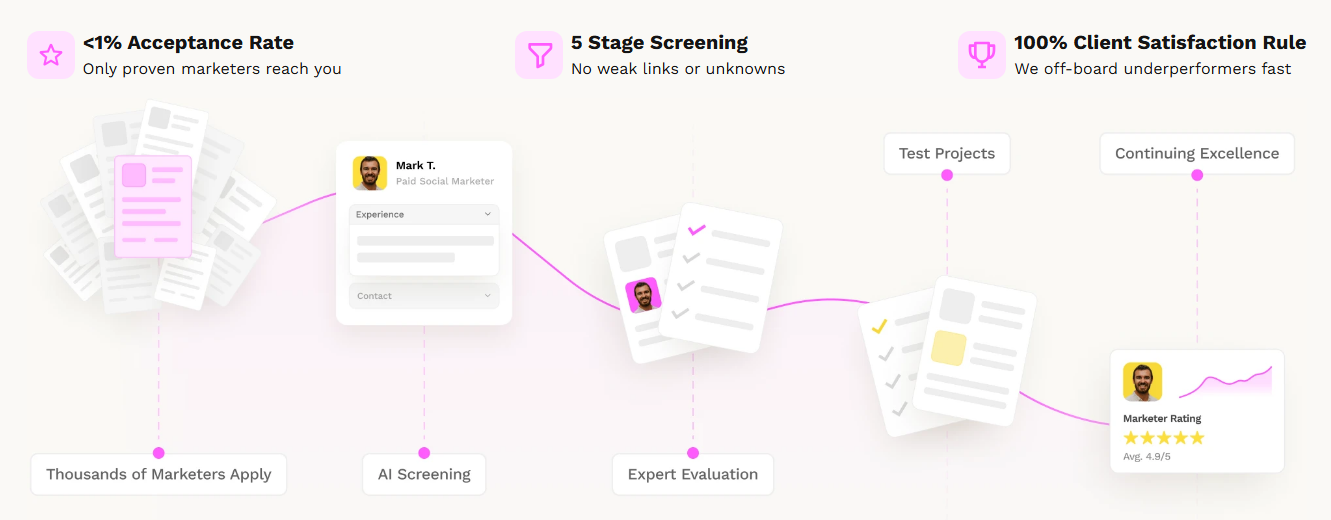
MarketerHire does only marketing. The network covers growth, paid media, SEO, lifecycle, content, and fractional CMO work, and the people matching you think in marketing terms rather than filling a generic req.
The platform uses a concierge approach. You do a short scoping call, and they hand you one or two matched candidates within a couple of days. Vetting is rigorous. Only a small fraction of applicants get in, and if their first match misses, there’s a trial window and a free rematch.
This platform is at the premium end of marketing talent platforms and operates on a subscription, which assumes you have real budget and rules out one-off tasks. The talent is senior and marketing-focused, built for strategy and channel work rather than high-volume creative production.
MarketerHire Strengths
- Marketing-only network and marketer-led matching, so you’re not explaining your field to a generalist
- Fast concierge shortlists with no profile-sifting, plus a trial-and-rematch safety net
- Best for a funded team that needs one senior specialist in a channel
MarketerHire Weaknesses
- Premium subscription pricing, not a good fit for small budgets and one-offs
- Built for strategy and execution, not creative production or design
- You rely on their pick rather than browsing the pool yourself
2. Right Side Up

Mit Right Side Up, you can bring on a single fractional specialist, build a custom team, or use their recruiters to make a full-time hire. This helps when you’re not yet sure whether your marketing gap needs a contractor, a team, or an employee.
Vetting is one of Right Side Up’s biggest strong suits. Marketers apply and go through a multi-step evaluation run by people who came out of in-house marketing roles themselves. Because the people judging the talent have done the work, the shortlist arrives already filtered on very high standards. In addition to vetting for talent and capabilities, they vet for AI fluency.
Marketers can help you build, learn, and expand your workflow with AI services. Terms are flexible: no long-term lock-in, hours that flex, and the freedom to hire their talent onto your payroll if it turns permanent. Right Side Up is strongest in growth and performance marketing, so it’s the best fit for gaps in acquisition, lifecycle, or analytics.
Right Side Up Strengths
- Spans fractional specialists, custom teams, and full-time recruiting in one relationship
- Vetting led by former in-house marketers who can tell real ability from an impressive resume
- Best for a growth-stage team that wants senior marketing help and isn’t sure yet whether a gap is a project, a team, or a hire
Right Side Up Weaknesses
- Less strong in creative or design production
- Senior talent at a premium, better for funded teams than tight budgets
- Built for strategy and execution, not quick one-off tasks
3. Toptal

Toptal is the largest premium vetted network of the group, though it started in software and expanded into marketing later, partly by acquiring the marketing-focused Growth Collective. But the platform still mostly focuses on engineering, design, and product, with marketing as a strong but newer wing. If you want one network that can staff a developer, a designer, and a marketer, that breadth is the draw.
The vetting is genuinely rigorous and the thing Toptal is known for. It accepts only a small percentage of applicants through a multi-stage screen that includes skills review, interviews, and a test project. Matching is concierge-style. Talent matchers who work in the field shortlist candidates against your brief, usually within a couple of days, and there’s a trial period to confirm fit.
You’ll pay premium prices for Toptal, and their service is optimized for enterprise and well-funded clients, so the economics don’t often work for small budgets. A marketing-native platform may understand a specialized brief more readily than Toptal, because marketing wasn’t their original strength.
Toptal Strengths
- Rigorous, well-established vetting and fast concierge matching with a trial period
- Broad network across engineering, design, product, and marketing under one roof
- Best for a funded team that wants senior talent across multiple disciplines, not just marketing
Toptal Weaknesses
- Premium pricing aimed at enterprise budgets, steep for small teams
- Marketing is a newer, secondary wing rather than the core focus
- Concierge-only; no browsing the pool yourself
4. We Are Rosie

We Are Rosie is a marketing- and creative-focused talent community built around flexible, project-based work. It leans toward brand, content, and creative roles, and it’s known for a large, diverse network of experienced marketers available for everything from a short project to an embedded team that plugs into your organization.
Matching is handled for you. You submit a brief and the team handpicks marketers who fit, drawing on their vetting process. For creative and content-heavy work, that curation gives you experienced people without needing to sift through a marketplace platform.
It’s generally a stronger fit for brand, content, and creative work, rather than for highly specialized growth or performance marketing.
Their model is lighter on ongoing account management, so it fits project and embedded-team work better than a long strategic partnership where you want a hands-on point of contact steering the engagement.
We Are Rosie Strengths
- Deep, diverse network for brand, content, and creative marketing work
- Handpicked matching from a vetted community, from single projects to embedded teams
- Best for creative and content needs, or flexible project and embedded-team staffing
We Are Rosie Weaknesses
- Thinner for senior growth, performance, and analytics roles
- Less built-in account management for ongoing, strategy-heavy engagements
- Better for defined projects than a long-term managed partnership
5. Mayple

Mayple pairs AI-driven matching with something most platforms don’t offer: an ongoing management layer.
You submit a brief, its system matches you with a vetted marketer from its network, and then a dedicated strategist monitors the work and gives you outside feedback on whether the marketing is actually performing. You get a freelancer plus oversight and limited analytics with their dashboards.
Their specialties are ecommerce and DTC growth, paid ads, email, social, SEO, and CRO, so it may fit online brands better than B2B or brand-heavy campaigns. The vetting is selective and data-based, weighing past performance rather than just profiles and reviews.
The managed model cuts both ways. The oversight reassures you if you can’t easily tell whether a marketer is performing, since Mayple’s team watches the work for you. But if you’d rather judge and manage the marketer yourself, you could be paying for a layer you don’t need.
Mayple Strengths
- Managed model with performance monitoring and an outside strategist, not just a match
- Selective, data-based vetting focused on proven results
- Best for ecommerce and DTC brands that want oversight, not just a freelancer to manage themselves
Mayple Weaknesses
- Strongest in ecommerce/DTC; not as strong for B2B or brand-led work
- The management layer adds cost and structure you may not need
- Less direct control if you’d rather manage the marketer yourself
6. Upwork
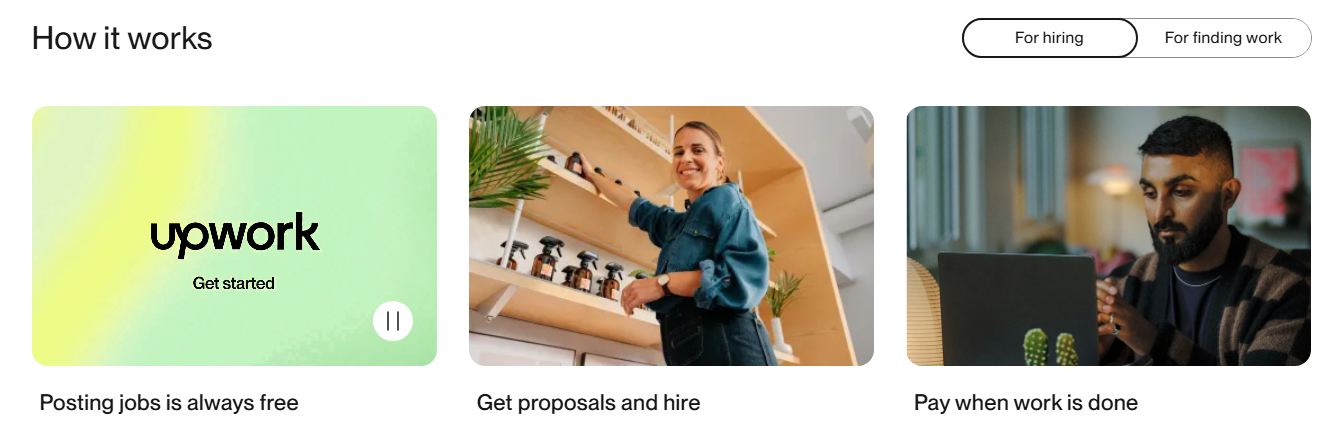
Upwork is an open marketplace where you post a job or search a massive global pool, negotiate rates directly, and manage the relationship yourself. Nobody scopes the role or vouches for who you hire, which is the source of both its appeal and its risk.
Vetting is reputation-based, built on ratings and reviews, job-success scores, and badges earned over time. Judging quality is your job.
Rates are lower than the curated platforms. You pay per contract rather than a subscription or retainer, and for a small, well-defined task that could be exactly what you need. But bringing in someone from Upwork costs you time. You write the brief, screen portfolios, interview, and occasionally deal with a bad-fit hire.
Upwork Strengths
- Large global pool of possible candidates and low per-project rates, with no subscription
- Best for defined, scoped tasks you can evaluate yourself
- Fast to post and hire when you know exactly what you need
Upwork Weaknesses
- Vetting is largely on you, so quality varies widely
- Poor fit for ongoing, strategic, or senior marketing roles
- The low rate is often offset by the time you spend screening and managing
What Separates the Best Marketing Talent Platforms?

The platforms in this guide fall into three broad models.
- Open marketplaces give you a huge searchable pool and hand you the work of sorting it. You post, you screen, you judge, you manage.
- Curated platforms provide vetting, so someone screens the talent before you ever see a profile. These companies typically match you to a shortlist.
- Traditional agencies sell you their own team and process for a defined scope, which means less flexibility and, frequently, senior people on the pitch and juniors on the work.
You can use the questions below to sort out which one is the best fit for you.
Who Does the Vetting, and Are They Marketers?
A platform can vet by checking a portfolio and confirming someone shows up on time, or it can put candidates in front of people who have actually run marketing teams and can tell whether a campaign result came from real skill. The first kind screens for reliability while the second screens for the thing you’re actually paying for.
On some of the strongest marketing-focused platforms, former marketers run the vetting process. That means the shortlist has already been screened by people qualified to judge the work, which saves you from having to guess.
How Senior is the Talent?
The word “expert” is doing a lot of heavy lifting on many of these platforms’ homepages. Some platforms are built around seasoned operators who have owned a channel or a function before; others are broad pools that run from junior freelancers to fractional executives, with the sorting left to you.
Neither is wrong, but they solve different problems. A senior specialist can tell you what to do; a capable executor does the thing you’ve already decided. Buying the second when you needed the first is one of the more expensive mismatches in this category.
Do they Actually Specialize in Marketing?
Some of these platforms do only marketing, and everyone doing the matching is thinking in marketing terms. Others are large general talent networks that added a marketing category alongside engineering and design.
The generalists can be excellent, but a marketing-native platform is more likely to understand the difference between a lifecycle marketer and a growth generalist, and to match accordingly. If your need is specific, specialization saves you from needing to explain the details of what you want.
How Does the Matching Work?
Concierge matching means you describe the need and the platform hands back one or two candidates who fit, which saves time.
Open marketplaces give you access to the entire pool and you choose, which gives you control but requires you to do the screening work.
Faster isn’t automatically better, it just depends on how much time you have to dedicate to narrowing down the field, screening candidates, and choosing the right one.
How Flexible Are the Terms?
The engagement terms are where platforms diverge sharply from agencies, and from each other.
Before you sign, look at whether you can scale hours up and down, how much notice it takes to end things, whether there’s a trial or rematch if the fit is wrong, and what happens if you want to hire the person full-time later.
What Are You Paying For?
Pricing models don’t compare cleanly across this category, which is part of why it’s confusing. Some platforms charge a subscription or membership, some price per engagement, some take a marketplace fee, and agencies typically bill retainers.
The number to compare isn’t the hourly rate, it’s the full cost of getting good work done. That includes the rate plus whatever vetting and management you need to do yourself, plus the cost of a false start if you get a mismatch. A higher rate that comes with real vetting could be the cheaper option once your time is considered.
How to Run a Trial or Test Project Before You Hire

Once you’ve chosen a platform and it’s matched you with someone, give that marketer a small, well-defined project before you commit to an ongoing engagement.
Pick a task that mirrors the real work they would be doing. If the platform gives you two candidates, brief them identically so you’re comparing the marketers, not two different sets of instructions. See how fast they respond, whether they ask good questions, understand your brief, and turn in high-quality work.
Always, always pay for trial work. Good marketers won’t work for free. A short paid project is fair, and it shows you how someone operates when there’s money and expectations on the table. The strongest platforms make this easy anyway, with trial windows and rematches built in.
No platform can guarantee the perfect marketer, but the best ones make it much more likely you’ll find the right fit without spending weeks sorting through candidates yourself. Focus less on the size of the talent pool and more on the quality of the shortlist, because that’s what ultimately determines whether your next marketing hire succeeds.




 English
  German
  Spanish
  French